
MERLIN AND PRESTER JOHN
THE HIDDEN KINGS

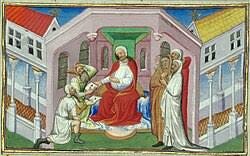
Medieval image of Prester John
You never know what you’re going to find when you go hunting through years of essays, stories and talks. In this case I found two talks give in 1983 and 1984, one for a Servants of the Light Conference, the other for a Hawkwood College event in the following year. Having looked these over, refreshed them here and there and added some pictures, here is the first of the two. They are closely linked by the enigmatic figure of Prester John, whose history I am currently exploring for a new book. The second will follow soon.
§§§
At first glance there may not seem to be much in common between the figures of the arch-mage of Britain and the mysterious Priest-King John. But once we look below the surface of their stories, some really fascinating evidence emerges; evidence which shows them to be very closely linked, almost in a direct line of succession, as archetypal guardians of the West.
Because he is by far the least well known of the two, we begin with Prester John, who is in fact such a shadowy figure that it is by no means easy to summarise what is known about him. Some fairly obscure areas of history have to be gone into before anything like a clear picture begins to emerge.
To begin with the name: “prester” is simply a contraction of “presbyter” or priest; but in fact Prester John is always referred to as Priest and King - an interesting point in itself, which brings to mind another figure who combines both of these functions - Melchizedek, who shares a lot more than this with Prester John. But there are some other questions we have to answer first - such as what Kingdom did Prester John rule over, and what God did he serve as a priest?
The first mention, little more than a rumour in fact, comes in a mediaeval chronicle which for the year 1145. It relates how a Catholic Bishop, described as coming from Jabala, in Syria, visited Rome and recalled how, some years earlier,
“a certain priest and king called John, who lives on the further side of Persia and Armenia, in the remote East, and who with all his people were Christians ... had overcome the royal brothers Samiradi, kings of the Medes and Persians, and had captured Ecbatana, their capital and residence .... The said John advanced to the help of the Church of Jerusalem; but when he reached the river [Tigris] he had not been able to take his army across the river in any vessel. He had then turned north, where he had learned that it was all frozen by the winter cold. He had lingered there for some time, waiting for the frost, but because of the mild weather was forced to return home after losing much of his army because of the unaccustomed climate.”
With a touch of colour the chronicler adds that “Prester John is said to be of the ancient lineages of the Magi who are mentioned in the Gospels, and to rule over the same people as they did, enjoying such glory and prosperity that he said to use only a sceptre of emerald...”
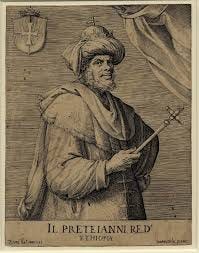
Prester John, seen as ruler of Ethiopia.