
MERLIN'S ESPLUMOIR
A Mystery of the World's Greatest Enchanter

MERLIN'S ESPLUMOIR
The Mysteries of the World’s Greatest Enchanter
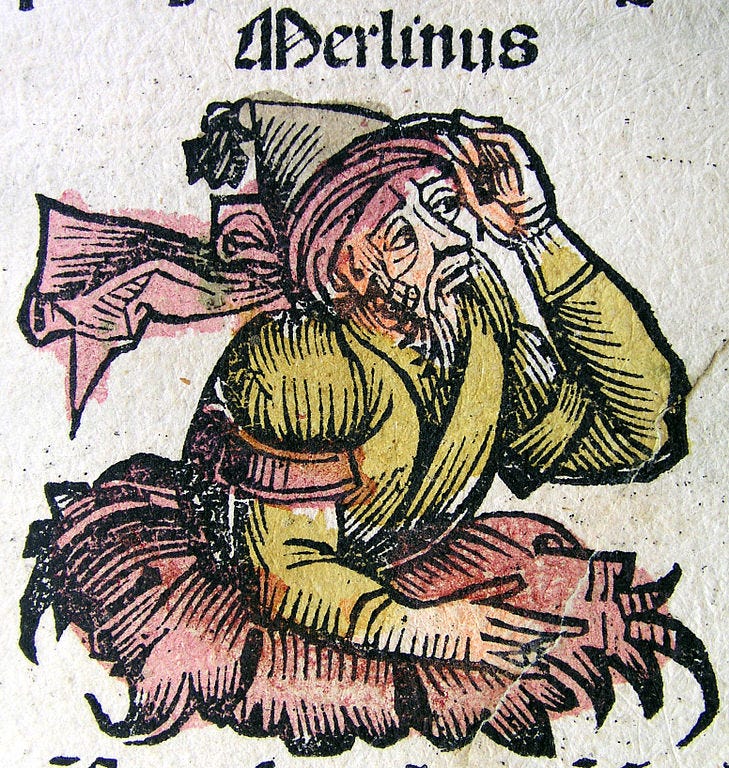
16th Century woodcut of Merlin
Towards the end of the 1990s R.J.Stewart and I put together a series of conferences exploring the figure of Merlin. We had some pretty high-powered guests for these – including the filmmaker John Boorman, the writer Peter Vansittart and the Merlin scholar Nickoli Tolstoy. Since then we have both published extensively on Merlin, with R.J. producing several books and The Merlin Tarot (1988) and myself The Book of Merlin (Amberley, 2022). Now, in preparation of my latest book, The Prophecies of Merlin(Inner Traditions, 2025, written with the sadly late Maarten Haverkamp) I thought I would show how there was a side to Merlin’s character that remained little known – his relationship with women - which was far more complex than the better known stories of his fall to the wily Nimue.
§§§
It has become customary to view the end of Merlin's career in a certain light: as an ageing magician captivated by a young woman. In this scenario Merlin is beguiled into giving away his greatest secrets in return for sexual favours; once the temptress - whose name may be Nimue Niniane or Vivienne - has succeeded in extracting this knowledge she at once uses it to imprison her aged lover, sometimes under a great rock, sometimes within a hawthorn bush, sometimes in a glass tower. From here he is said to utter elusive prophecies or gnomic sayings, while in some versions the 'Perron de Merlin', Merlin's Stone, becomes a starting point for adventure, to which those in search of the strange or the mysterious resort, to await events or instruction.
Such is the story which Malory, for instance, gives us in the Morte D'Arthur, Book IV, Chap. i.
'Merlin fell in a dotage on the damosel that King Pellinore brought to court, and she was one of the damosels of the lake, called Nimue. But Merlin would let her have no rest, but always he would be with her. And ever she made Merlin good cheer till she learned of him all manner thing that she desired; and he was assotted on her, that he might not be from her ... And so, soon after, the lady and Merlin departed ... and always Merlin lay about the lady to have her maidenhead, and she was ever passing weary of him, for she was afeared of him because he was a devil's son, and she could not be rid of him by no means. And so on a time it happed that Merlin showed her in a rock whereat was a great wonder, and wrought by enchantment, that went under a great stone. So by her subtle working she made Merlin to go under that stone to let her wit of the marvels there; but she wrought so there for him that he came never out for all the craft he could do. And so she departed and left Merlin.'
Tennyson, four hundred years on, reinforced this in Victorian dress in his poem 'Merlin and Vivien' from The Idylls of the King; but there is another version. In this story, which we find in Geoffrey of Monmouth's Vita Merlini,' the Didot Perceval and various other texts, Merlin has reached a great age, or a particular stage of spiritual development, and decides to retire from the world of his own accord. He is, sometimes, still accompanied by a female companion, though, as in the Vita, it is more likely to be his sister than his lover, and the place of retirement may still be a tower, an island or a cave, but these are places of Merlin's own choosing or even construction.
The question is: which of these two versions is the right one, if indeed there is a right one; and which motivation - lust or continued growth should we believe? To answer this we have to ask another question: Why should Merlin withdraw from the world? I have already suggested one answer: that he sought further knowledge or the opportunity to grow. Fortunately there are several other figures, though from a different tradition, each of whom shares some of Merlin's attributes as prophet, mystic, and seer, and has a specific reason for withdrawing. Consideration of these figures may help to clarify matters.
The figures in question are generally known by the term 'hidden' or 'inner' kings, beings who have responsibility for a particular aspect of tradition or teaching and who continue to administer this even after they have withdrawn from active participation in the events of the world, although they are not actually dead. Among the most notable are Melchizadek, Enoch, Elijah and, 1 believe, Merlin himself.
Despite their many differences these figures share certain important aspects. They are all mysterious, shadowy beings, who appear at a time of crucial import, and who seem to have neither an orthodox beginning nor end to their lives. Finally, they each withdraw or disappear, leaving conflicting accounts of their actual existence, function or allegiance.
Melchizadek, was 'without beginning or end while Enoch 'walked with God and was not' but beyond this seems to have no point of origin. He is first mentioned, in Jewish traditional sources - significantly as we shall see - as living in a hidden place, from which he watches and records the deeds of mankind and holds occasional converse with God. Later he is represented as a king over men who ruled for more than two hundred years before being summoned by God to rule over the angelic hosts.
To this rather sparse account we can add, from various other sources, that Enoch visited heaven often while still in the flesh, and that he was instructed by the archangel Michael in all things, after which he wrote some 366 books, which may well remind us of the 333 prophetic books of Merlin ...
When translated to heaven Enoch had bestowed upon him 'extraordinary wisdom, sagacity, judgement, knowledge, learning, compassion, love, kindness, grace, humility, strength, power, might, splendour, beauty, shapeliness and all other excellent qualities', and received besides 'many thousand blessings from God, and his height and breadth became equal to the height and breadth of the world, and thirty-six wings were attached to his body to the right and to the left, each as large as the world, and three hundred and sixty-five thousand eyes were bestowed upon him, each as brilliant as the sun ... " The description continues for several more paragraphs, outlining a truly cosmic figure. At the end it is revealed that Enoch - whose name, not surprisingly perhaps, means 'the enlightened one' received a new name. As the text puts it:
'A magnificent throne was erected for him beside the gates of the seventh celestial palace, and a herald proclaimed throughout heaven concerning him, who was henceforth to be called Metatron. God declares:---I have appointed my servant Metatron as prince and chief over all other princes in my realm ... whatever angel has a request to refer to me, shall appear before Metatron, and what he will command at my bidding, ye must observe and do, for the Prince of Wisdom and the Prince of Understanding are at his service, and they will reveal unto him the science of the celestials and the terrestrials, and knowledge of the present order of the world, and the knowledge of the future order of the world. Furthermore have 1 made him guardian of the treasures of the palace of heaven, Arabot, and of the treasures of life that are in the highest heavens.’
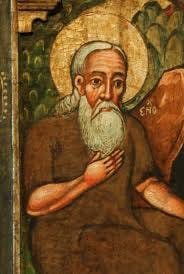
Icon of Enoch
Enoch has thus become a Lord of Hosts and a guardian of the Treasures of Life in heaven. More interestingly perhaps he is also said to have assumed the position left vacant by the fall of Lucifer. He is thus balancing out the uneven ranks of the angelic host, and perhaps it is not stretching the analogy too far to see here an echo of the place left empty at the Round Table, which will one day be filled by the destined champion of the Grail. 1 think also that in the description of the revelation of the sciences celestial and terrestrial, the knowledge of present and future, we have another analogy of the knowledge and wisdom of Merlin, derived from within his observatory with its 70 doors and windows.'